QuartierScore

For UK · US · IE · AU buyers — €19.90

Found a French property you like?
Check the address before you sign.

French rules affect what you pay, whether you can rent it out, what renovations may be required, and which risks the seller must disclose. Get a plain-English report for one address, based on official public data (DGFiP, ADEME, INSEE, Géorisques, ARCEP).

We do not replace the notaire. We help you know what to ask before you commit.

Delivered by email in <60s. 30-day download link. Indicative report.

PDF delivered to your email within 1 minute · 30-day download link · Refund if the report contains a factual error.

What changed in 2026

5 regulatory shifts foreign buyers miss

French real estate regulation moved more in 18 months than in the previous decade. Most online translations and expat forums still quote pre-2025 rules. The table below summarises what changed.

DPE 2026 coefficient change

1 January 2026
What changed
Electricity primary-energy conversion coefficient: 2.3 → 1.9 (arrêté of 13 August 2025). Improves the electricity calculation and can lift some electricity-heated homes by one class (some stay in the same class; the final class can also be limited by CO₂ emissions). Does not apply in the DROM / overseas departments (coefficient 3.5 retained there).
Who's affected
~43% of French housing stock (35% electric direct + 8% heat pump). About 850,000 homes change rating without any renovation (MTECT estimate).
Your report shows
Your specific address: before / after class + kWhep/m²/year. If your electric-heated property was G under the old method, our calculation tells you whether it's now F (still banned in 2028) or escapes the ban entirely.

DMTO notary tax majoration

1 June 2025 → 31 March 2028 (sliding window — most départements applied 1 June 2025)
What changed
Loi de finances 2025 article 116 allowed départements to raise the departmental share of "droits de mutation" from 4.50% to 5.00%. About 88 metropolitan départements adopted the majoration. The Indre (36) is the only metropolitan département still below 4.50%, at 3.80%; among the overseas départements, Mayotte (976) is at 3.80% and the others are generally 4.50%.
Who's affected
Every buyer in a département at 5.00% (about 88 of them). On a €500,000 purchase: extra €2,500 in transfer taxes vs. pre-2025.
Your report shows
Exact DMTO rate for your département (3.80% for Indre and for Mayotte, 4.50% for most other DOM, 5.00% otherwise; primo-accédant 4.50% if first-time buyer of a primary residence per CGI 1594 F septies + décret 2025-946, 5-year residence engagement, no price cap).

DPE rental ban calendar tightens

Already in force / ongoing
What changed
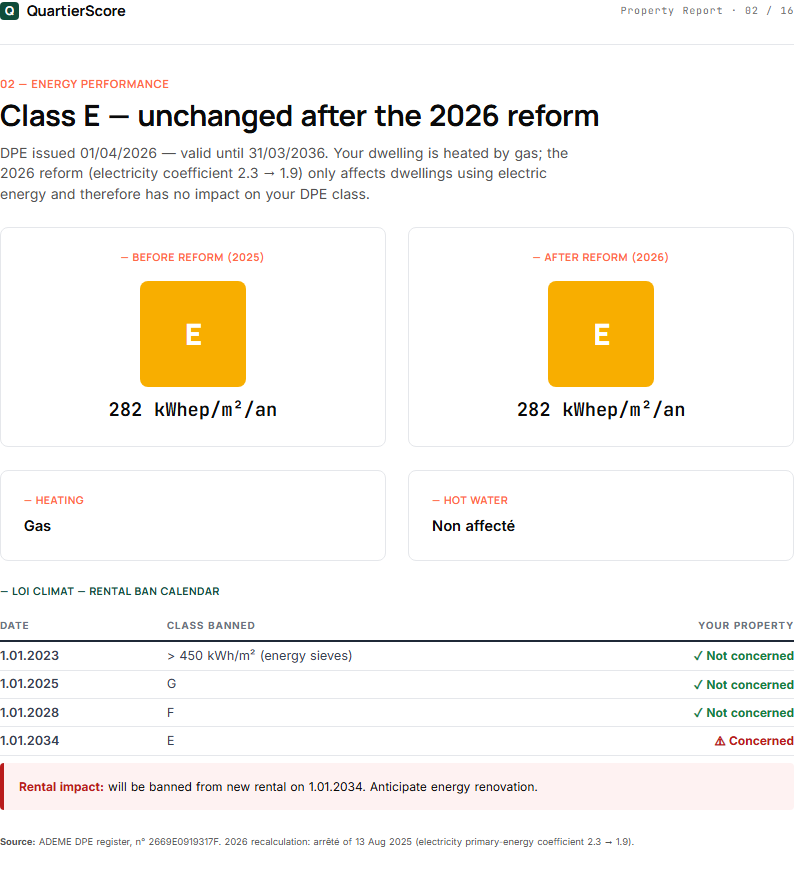
Class G: banned from new rentals since 1 January 2025. Class F: banned from 1 January 2028. Class E: banned from 1 January 2034. In DOM: G banned 1 January 2028, F 1 January 2031, E not yet published.
Who's affected
Landlords with F/G classed property facing forced renovation (€20-60k typical) or sale at distressed price. Buyers can negotiate aggressive discounts on F/G rental property.
Your report shows
Your property's class + how long until ban + estimated renovation cost (€20-60k for E/F/G) + which exact works the DPE recommends (heat pump, insulation, glazing).

LMNP capital-gains reform

15 February 2025
What changed
Loi de finances 2025 article 84 amended CGI article 150 VB III to reintegrate accumulated depreciation into the taxable capital gain at sale of LMNP-status property. It ends the earlier situation where depreciation reduced taxable rental income each year without being added back when the property was sold.
Who's affected
LMNP investors selling from 15 February 2025 onward (subject to the legal exceptions for certain serviced residences). For a €200,000 property held 10 years with €40,000 accumulated depreciation: ~€8,000 additional tax at sale.
Your report shows
If you're a foreign investor considering LMNP status (furnished rental), our Variant G report (€24.90, French only) computes your specific scenario. For an English-language LMNP summary, see the appendix in this Variant F report.

LFSS 2026 social-charges increase

1 January 2026
What changed
The 2026 social-security finance law (LFSS 2026 — Law no. 2025-1403 of 30 Dec 2025) raised CSG on capital mobilier (LMNP furnished rental income, dividends, interest) from 9.2% to 10.6% effective 1 Jan 2026, lifting total social charges to 18.6%. Unfurnished rental and real-estate capital gains remain at 17.2%. Confirm your situation with an accountant.
Who's affected
LMNP investors: 1.4 percentage point hike on net rental income. For €15,000/year rent, ~€210 extra tax.
Your report shows
Quantified impact on your scenario in the Variant G LMNP report.

By region

Where foreign buyers actually buy — and what to watch for

~14,000-15,500 non-resident purchases in France per year, average €375,455 per transaction (63% above the French national average). Concentration varies dramatically by région. Each region has its own dominant risk.

Paris (75)

pop. 2.1 million

Key risk: Rent caps + DPE rental ban

Strict encadrement loyer with arrondissement-specific reference rents (€33-45/m² depending on building age and apartment size). 13% of stock is rated F/G — the rental ban will hit Paris hardest in 2028. Notary fees: 5.00% DMTO (majoré 2025) + ~1.32% communal & state fees = 6.32% total state taxes, plus notary scale and disbursements ≈ 7-8% total. Insurance against the rental ban: pre-2026 electric-heated apartments can jump 1 class under the new DPE method.

Suggested for: Pied-à-terre buyers, urban investors

Côte d'Azur / French Riviera

pop. 1.1 million

Key risk: Foreign-buyer concentration, premium pricing

20% of all non-resident French property purchases happen here (Alpes-Maritimes and the wider Riviera, incl. Saint-Tropez in the Var). Cannes, Nice, Antibes average €375,000+; villas €1-3M. Belgian, Swiss and British buyers are well represented, and international demand can create strong local price premiums in specific neighbourhoods. Rent caps are usually less central here than the price premium, DPE and natural-risk checks. Notary fees full 6.32%. Seismic zone 4 (modéré), increasing flood risk on coastal communes. Our report quantifies the price premium vs. comparable inland properties.

Suggested for: Second-home buyers, luxury market

Provence / Var (83)

pop. 1.1 million

Key risk: Clay shrink-swell (RGA) cracks, wildfire

RGA (retrait-gonflement des argiles) is the #1 cause of structural cracks in Provence — about 55% of the département is in moyen/fort zones. For building plots, a G1 geotechnical study (€800-1,500) is mandatory before sale. Existing houses: G1 strongly recommended for negotiation. Wildfire risk: 30+ communes under PPRif (plan de prévention des risques incendie de forêt). Our Géorisques section maps the exact exposure for your address.

Suggested for: Country home buyers, ex-urban relocators

Dordogne (24)

pop. 420,000

Key risk: Pricing volatility, partial regulatory coverage

Historic favourite for British buyers (post-Brexit declining but still 17% of UK buying outside Paris). Property prices stable to falling (-12% in 5 years for stone houses needing renovation). Rent caps are usually less central here than price, DPE and natural-risk checks. Notary fees: full 6.32%. Metropolitan French DPE and rental rules apply. Our report flags villages where Brits resell to other Brits (price-pocket detached from regional median).

Suggested for: Country retreat buyers, retirees, British expats

Indre (36)

pop. 215,000

Key risk: Limited buyer pool, lowest French prices

France's cheapest département for residential property (~€800-1,200/m² for stone houses). DMTO at the historic 3.80% rate (Indre kept the lower rate vs. the 5.00% departmental majoration adopted by about 88 metropolitan départements) = total transfer taxes ~5.09% instead of 6.32%. Among the overseas départements, Mayotte (976) is also at 3.80%. Very thin DVF data — our trend interpretation explicitly flags "small sample, indicative only" when there are fewer than 10 sales in 5 years. Rent caps are usually less central here than price, DPE and natural-risk checks.

Suggested for: Cash buyers, renovation enthusiasts, very-low-budget buyers

DOM (Guadeloupe, Martinique, Réunion, Mayotte, Guyane)

pop. 2.2 million

Key risk: Different calendar, seismic exposure, cyclones

The Loi Climat rental-ban calendar is shifted by 3 years vs. metropolitan France (G banned from 1 January 2028 instead of 2025, F from 2031 instead of 2028; E threshold not yet published). The DPE 2026 coefficient change (2.3 → 1.9) does NOT apply in DOM — the legacy coefficient of 3.5 is retained. DMTO: Mayotte stays at 3.80%; Guadeloupe/Martinique/Guyane/Réunion generally at 4.50% (no majoration). Seismic zones 4-5 (Antilles), zone 3 (La Réunion). Hurricane / cyclone risk in Antilles (Maria 2017, Irma 2017 reference cases). Our report includes a specific DOM disclaimer + DEAL (Direction de l'Environnement, de l'Aménagement et du Logement) contact reference for territory-specific verification.

Suggested for: Tax-optimisation buyers (LMNP overseas), expat retirees
The €19.90 report

16 pages, your address, plain English

PAGE 1

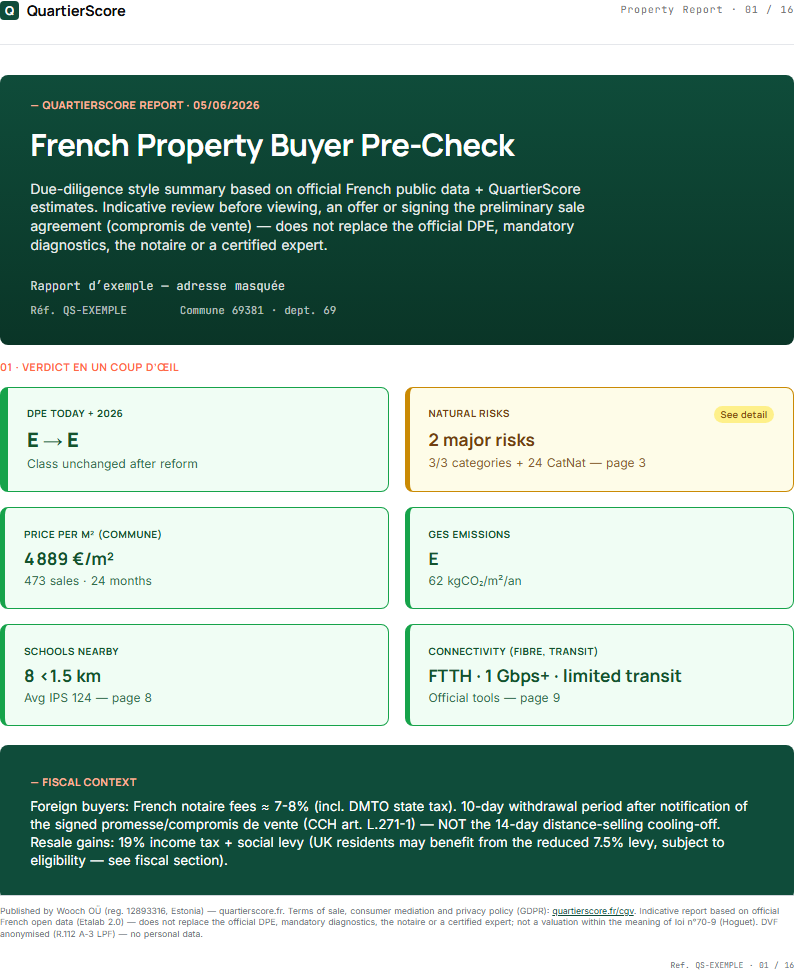
Verdict cover

One-glance summary across 7 dimensions: energy, risk, price, transit, schools, fibre, market.

PAGE 2

DPE today + 2026

Current class + projected 2026 class under the new coefficient. €/year energy bill estimate.

PAGE 3

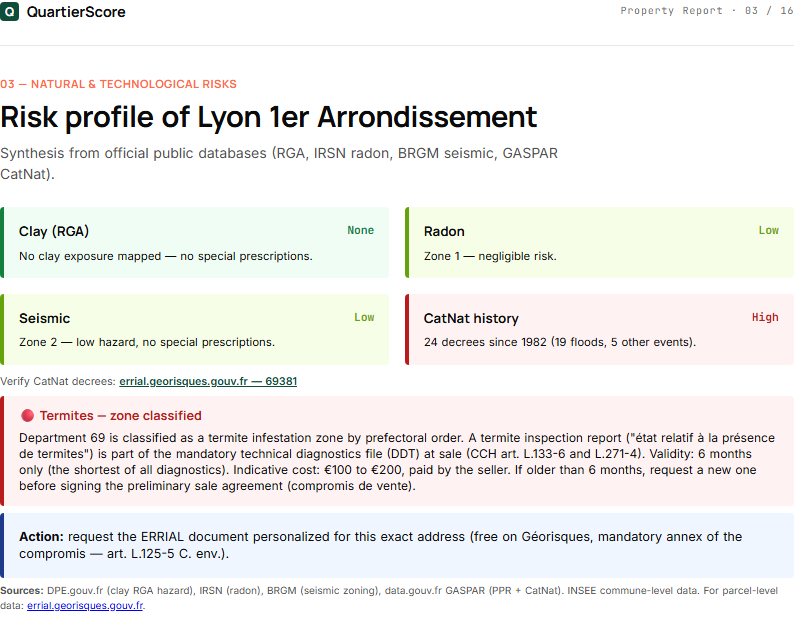
Natural risks

Géorisques: clay shrink-swell (RGA), radon, seismic, floods, declared CatNat events.

PAGE 4

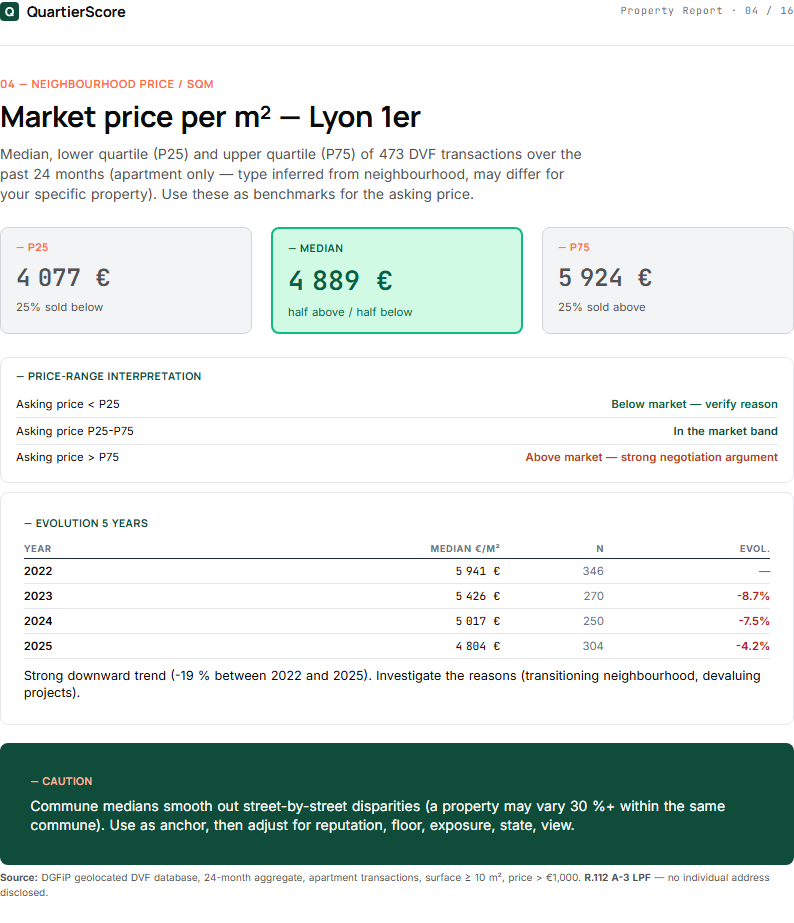
Price per m² (commune)

5-year DVF history (real recorded sales), median + percentiles, trend interpretation.

PAGE 5

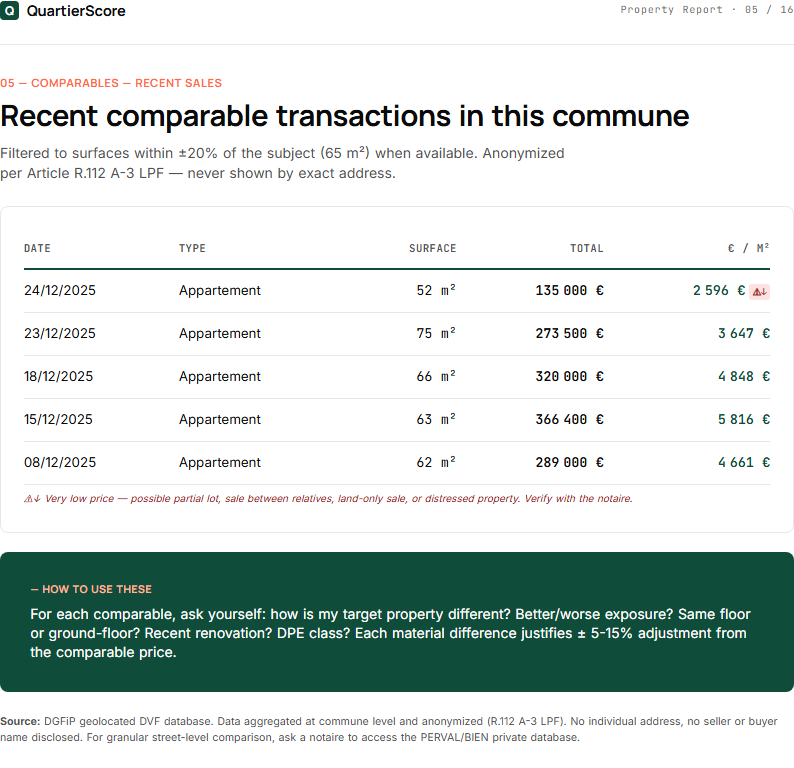
Comparables (5 sales)

Most recent comparable apartments/houses sold in the commune.

PAGE 6

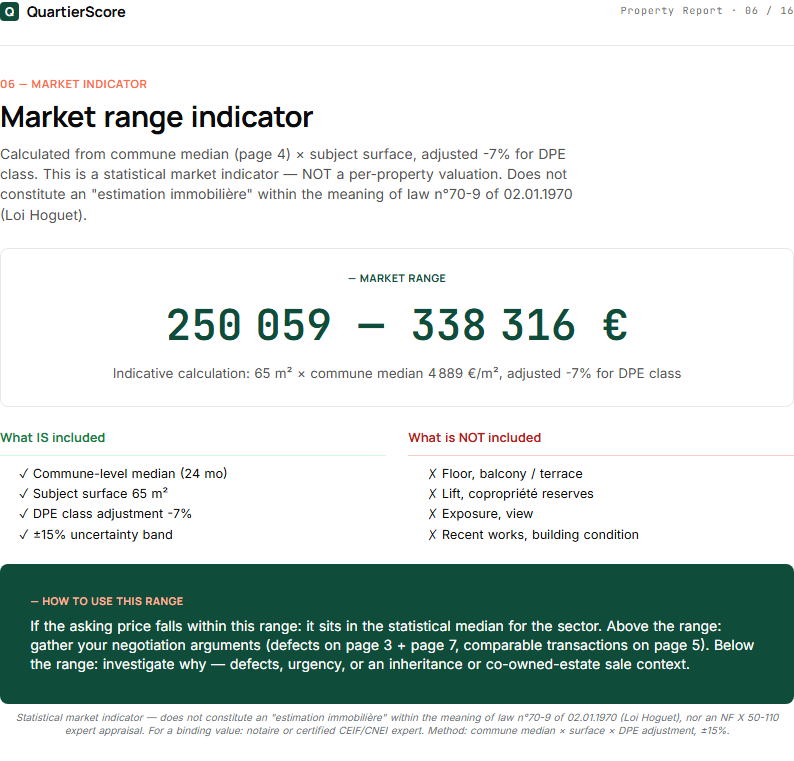
Indicative valuation

Price band based on commune median × surface × DPE adjustment. With method disclosure.

PAGE 7

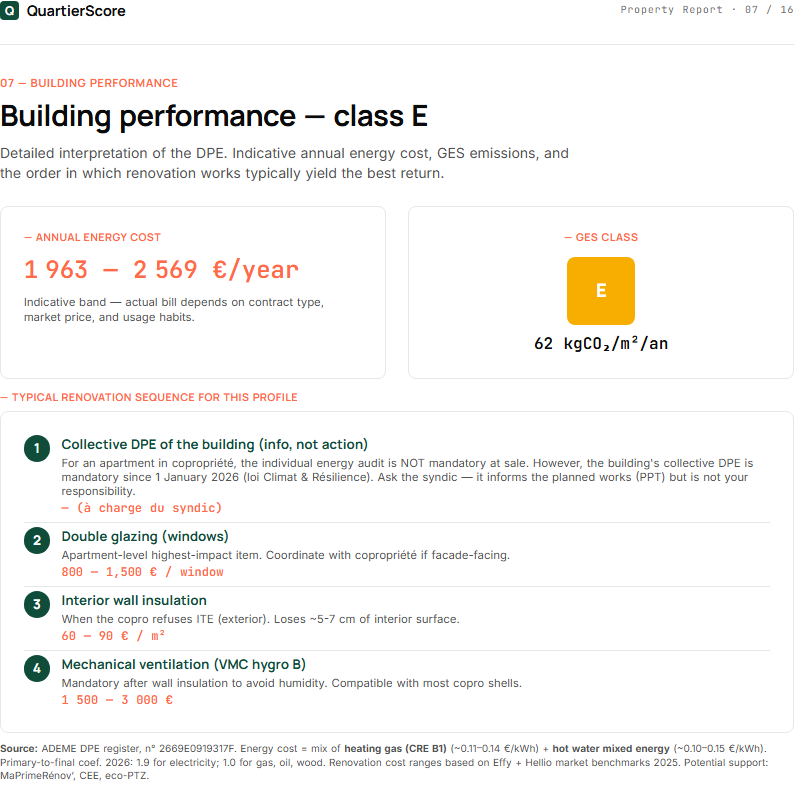
Building performance

Detailed DPE, heating system, GES emissions, recommended renovation works + costs.

PAGE 8

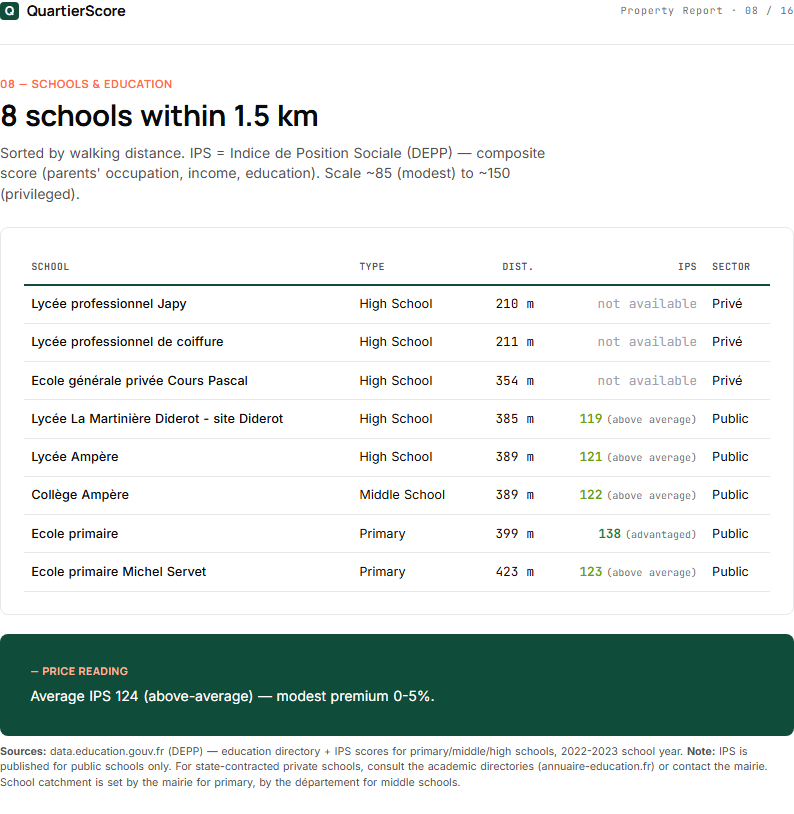
Schools + IPS

Schools within 1.5 km + IPS (social-position index) — public schools only.

PAGE 9

Fibre + transit

FTTH eligibility, GTFS metro/RER/bus stops within 500m, mobile coverage.

PAGE 10

Address specifics

Prior DPEs on same building, DVF transactions on this exact parcelle (legal per R.112 LPF).

PAGE 11

Living environment

IRIS-level INSEE: median income, age profile, ownership %, schools, shops within walking distance.

PAGE 12

Annual costs

Taxe foncière estimate, energy cost, copropriété charges (if applicable), 10-year works horizon.

PAGE 13

Financing & total cost

Notary fees breakdown (DMTO + emoluments + disbursements), 3 credit scenarios @ Q1 2026 rate.

PAGE 14

Foreign-buyer context

Currency, financing, French tax questions, non-resident resale points and what to ask the notaire.

PAGE 15

Checklist before compromis

10-point action list: documents to request, inspections to make, clauses to negotiate.

PAGE 16

Ready-to-send emails

Pre-written emails to seller / agent / syndic to request the documents you need.

04The report

Your buyer report, page by page.

A 16-page English dossier: DVF neighbourhood prices, DPE 2026, Géorisques, schools, transport, notary fees and the questions to ask the seller.

Real preview — example
  • Property Report — page 1

    01

  • Property Report — page 2

    02

  • Property Report — page 3

    03

  • Property Report — page 4

    04

  • Property Report — page 5

    05

  • Property Report — page 6

    06

  • Property Report — page 7

    07

  • Property Report — page 8

    08

Use the arrows or swipe to browse 8 sample pages. The full PDF is delivered after purchase. Example data from the public ADEME register.

Indicative — not legal advice

The report is a synthesis of public-government data.
It does not replace a notaire or expert opinion.

For binding decisions, consult a French notaire (transaction), expert-comptable (taxation if renting out), avocat (legal disputes), or licensed diagnostiqueur (official DPE certificate). Our report tells you what questions to ask them.

Sources cited on every page: Légifrance, INSEE, DGFiP, ADEME, Géorisques, ARCEP, ANAH, France Rénov'.

Frequently asked

Foreign-buyer FAQ

I do not live in France. Can I still buy a French property?

Yes. In general, foreign buyers can buy residential property in France without a nationality-based restriction; the usual checks still apply (identity, source of funds, financing, notarial due diligence). You will need a French notaire (mandatory by law for the deed) and typically a French bank account or an international transfer. Some French banks and specialist brokers may finance non-resident buyers, usually with more documentation and a higher deposit than for French residents. Cash buyers face the lowest friction.

What is the DPE 2026 reform and why does it matter?

The DPE (Diagnostic de Performance Énergétique) is France's mandatory energy rating from A (best) to G (worst). On 1 January 2026 the calculation method changed: the electricity-to-primary-energy coefficient dropped from 2.3 to 1.9 (arrêté of 13 August 2025). This mechanically lifts about 850,000 electric-heated homes by one class — without any renovation. The reform matters because class G is already banned from new rentals (since 1 January 2025), class F is banned from 2028, class E from 2034. A property moving from G to F is no longer treated as a G-rated home, but it can still be affected by the F rental ban from 2028. Our report computes the new class for your specific address.

What are the "rent caps" (encadrement des loyers) and where do they apply?

In 9 designated agglomerations the préfecture sets a maximum rent (€/m²) by neighbourhood, building age and apartment type. Renting above the cap exposes you to administrative fines (up to €5,000, €15,000 for legal entities) and 3-year retroactive refund obligations. The 9 areas in 2026: Paris, Lille (+Hellemmes, Lomme), Lyon (+Villeurbanne), Plaine Commune (Saint-Denis area), Est Ensemble (Montreuil/Bagnolet area), Bordeaux, Montpellier, Pays Basque (24 communes), and Grenoble-Alpes Métropole (21 communes). Lyon's framework was briefly contested in October 2025 but reinstated by a new prefectural decree on 1 November 2025.

How much are notary fees ("frais de notaire")?

For an existing property (>5 years old): about 7-8% of the purchase price, split between the departmental transfer-tax share (DMTO, raised to 5.00% in about 88 metropolitan départements since 1 June 2025 — Loi de finances 2025 art. 116), the communal share (1.20%), state assessment fees (~0.12%), notary émoluments on a regressive scale (~0.8-3% depending on price, +20% VAT), disbursements (~€1,200), and the property security contribution (0.10%). New-build (<5 years, "VEFA") is much cheaper at ~2-3% because the reduced 0.715% departmental rate applies (VAT 20% is already included in the developer's price — it is NOT added by the notary). The Indre (36) is the only metropolitan département still below 4.50%, at 3.80%. Among the overseas départements, Mayotte (976) applies 3.80% and the others (Guadeloupe, Martinique, Guyane, Réunion) generally 4.50%. A first-time buyer of a primary residence retains the 4.50% rate (CGI art. 1594 F septies + CCH L.31-10-3 + décret 2025-946 of 8 September 2025, 5-year residence engagement, no price cap). Our report runs the precise calculation for your specific transaction.

Which report should I choose — French or English?

Pick by the language and depth you need, not by where you are from. The French report (€14.90) covers everything any buyer needs, with destination-specific notes where relevant (FR–BE tax treaty, LEX KOLLER for Swiss buyers, Luxembourg patrimony declaration) — it is the same €14.90 for everyone, French or not. The English report (€19.90) is the same address analysis, fully in plain English, with the French property system explained from scratch, amounts converted to your currency (£/$/CHF, ECB reference rates), a "what foreign buyers commonly miss" guide, and the cultural context of the notaire process and the 10-day cooling-off period (art. L.271-1 CCH). The higher price reflects the extra translation and explanation work — not your nationality. Most French-speaking buyers (incl. Belgian, Swiss, Luxembourg, Quebec) are best served by the French report.

What about taxes after I buy?

Annual taxes include taxe foncière (property tax, ~0.5-2% of "valeur locative cadastrale" depending on commune — typically €500-3,000/year for a €300k apartment), taxe d'habitation (abolished on primary residences in 2023 but kept on secondary residences ~€400-2,500/year), and if rented out: rental income tax (BIC if furnished, foncier if unfurnished) + social charges on furnished rental income (the 2026 social-security finance law (Law no. 2025-1403 of 30 Dec 2025) has raised CSG since 1 Jan 2026, lifting total social charges to ~18.6% on LMNP furnished rental income; unfurnished rental and real-estate capital gains stay at 17.2% — confirm your situation with an accountant). For non-residents: rental income is taxable in France first (treaty applies), then declared in your home country with relief. Our LMNP investor report (Variant G, €24.90 — French only) walks through the optimisation.

Why €19.90? What's the difference vs. an agent's free dossier?

Estate agents in France are paid by the seller (3-7% commission) — their role is not the same as an independent buyer's adviser. Our report is paid by you, the buyer; we have no incentive other than accuracy. We pull from 10+ official open-government datasets (DGFiP, ADEME, IGN, Géorisques, INSEE, ARCEP, ANFR) and synthesise into a 16-page actionable dossier. The €19.90 covers our database hosting, ETL pipelines, and the PDF rendering pool. We deliver in under a minute by email — no sales call, no follow-up spam, no data resold.

Is the report a legal document?

No — and we are very clear about this. The report is "indicatif" (indicative): a synthesis of public-government data to help your due-diligence process, not a legal opinion or certified expert valuation. For binding decisions, consult: notaire (transaction), expert-comptable (taxation if renting out), avocat (legal disputes), certified diagnostiqueur (official DPE), licensed expert (NF X 50-110 valuation for divorce/succession). Our report tells you what questions to ask them.

Buying property in France?

€19.90. 16 pages. English. Your address. 2026 regulations decoded. Delivered to your email in under 60 seconds.

Belgian, Swiss, Luxembourg or Quebec? French-language Variant A (€14.90) is better-fitted for you — see French version.

Check your address

Free preview before payment